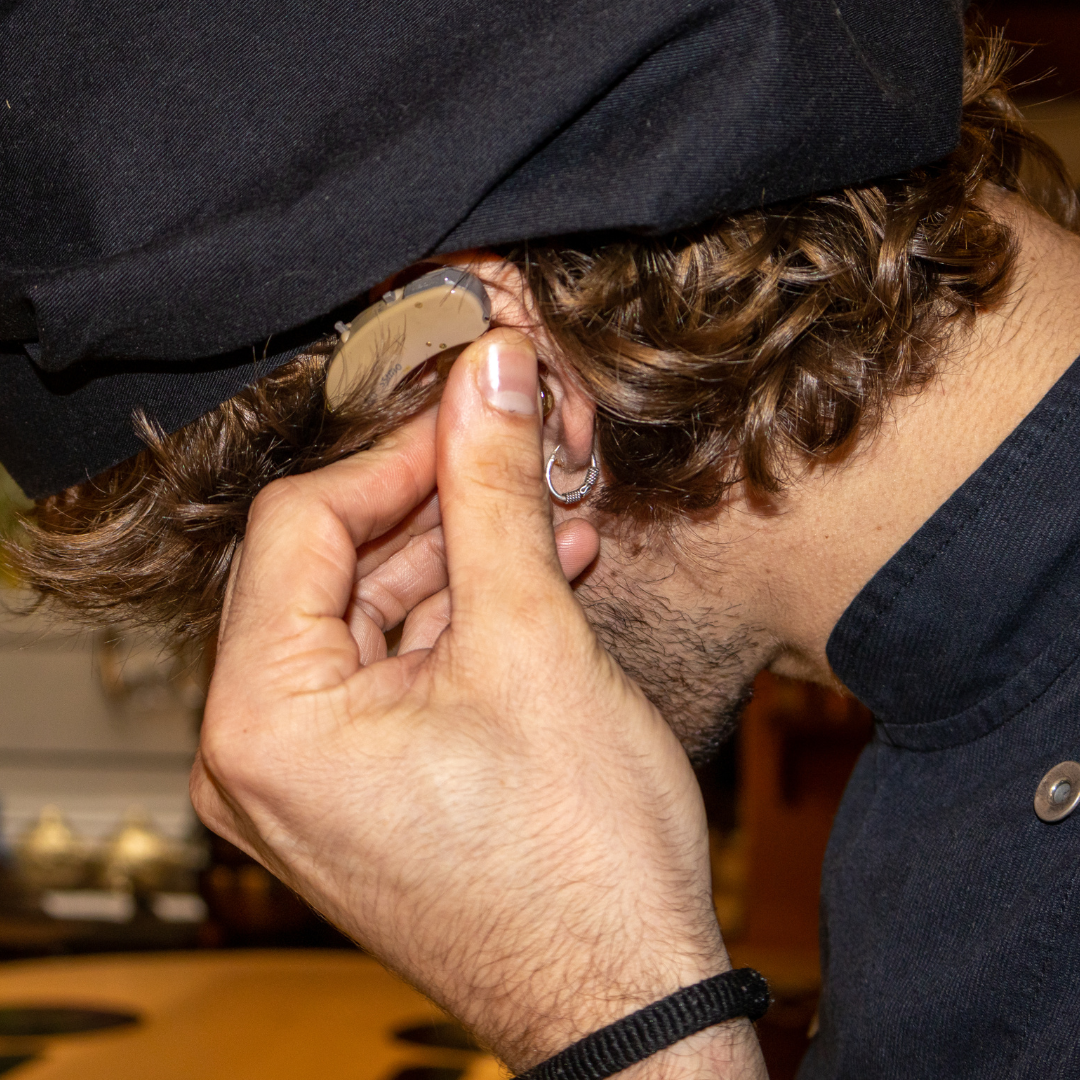
Maintaining dinner dialogue proves demanding when chaotic ambient noise strains your concentration and hearing. Our practice can evaluate hearing in both quiet and noisy conditions to identify what makes these environments difficult. After uncovering the precise factors driving your difficult hearing, our team helps you select individualized auditory solutions.
Why Do I Hear Well in Quiet but Struggle in Restaurants?
A tranquil environment produces a beneficial signal-to-noise ratio where spoken dialogue easily overpowers weak ambient noise. Commercial restaurant spaces present the polar opposite acoustic dynamic. Background voices, loud music, service clatter, and wall reflections collide with spoken words, demanding heightened cognitive processing to isolate individual speech.
Such difficulty frequently signals sensorineural high-frequency hearing loss, auditory processing dysfunction, or noise-induced cochlear damage. Visual limitations from low lighting, cognitive fatigue, and sitting farther away from conversational partners amplify speech degradation. Many individuals register normal audiometric thresholds on standard pure-tone screenings yet show profound deficits during speech-in-noise testing. Difficulty in restaurants deserves evaluation even when everyday hearing seems normal.
The Audiological Process for High-Frequency Hearing Loss
Diagnostic assessment begins by documenting specific listening breakdowns, recreational noise exposure, tinnitus symptoms, medications, and hereditary auditory patterns.
Diagnostic pure-tone audiometry establishes the softest auditory thresholds you can perceive across standardized frequencies via air and bone conduction pathways. In high-frequency hearing loss, the audiogram reveals a sloping configuration where hearing acuity drops progressively as pitch frequencies increase. Further clinical diagnostics feature tympanometry to evaluate eardrum and middle-ear mechanics as well as word-recognition testing for speech comprehension.
A quiet sound booth cannot replicate complex dining room acoustics, which makes clinical speech-in-noise testing especially informative. It measures how well you recognize words or sentences as competing sounds become louder. Collectively, these evaluations clarify if your challenges relate to raw audibility, phonetic clarity, signal-to-noise processing, or compound factors.
Adult Auditory Processing Disorders and Speech Perception
A central auditory processing disorder disrupts the neurological transmission and cognitive interpretation of sound waves. The ears may detect tones at expected levels, but the brain may have difficulty organizing competing signals, distinguishing similar speech sounds, or following rapid conversation. Our clinical team starts by examining peripheral auditory thresholds, subsequently deciding if an auditory-processing test battery or multidisciplinary consultation is necessary.
Effective Techniques to Hear Better in Noisy Surroundings
Small, intentional adaptations can optimize the clarity of speech reaching your ears and leverage helpful visual speech cues. Before dining out, choose a quieter restaurant or visit during an off-peak time. Restaurants featuring plush booths, wall acoustic panels, heavy drapery, carpeting, and sound-dampening materials provide superior listening compared to open rooms with reflective surfaces.
Upon entering the restaurant:
- Ask host staff for a quiet table distanced from kitchen traffic, bar noise, audio speakers, and loud group tables.
- Choose a seat with your back against a solid wall to block acoustic clutter originating from behind.
- Seat yourself facing conversation partners under clear, bright lighting to facilitate visual speechreading.
- Sit as close to the speaker as comfort permits to preserve speech volume and clarity.
- Direct your better-performing ear toward the companion you most need to understand.
- Request that companions rephrase misunderstandings using different words rather than repeating the same sentence.
- Actively confirm key information rather than smiling and guessing at ambiguous dialogue.
- Step into a quiet area for a few minutes when listening fatigue begins to compromise focus.
- Request that dining partners articulate words distinctly at an unhurried, natural speed.
- Elevated yelling distorts auditory signals and seldom improves actual phonetic comprehension.
Advanced Technology for Hearing in Background Noise
Determining the proper hearing technology hinges on the underlying disorder, everyday listening environments, and whether peripheral hearing loss is diagnosed. Professionally fitted hearing aids may use directional microphones, digital noise reduction, and dedicated restaurant programs to emphasize speech from the front and reduce some competing sound. Users should establish realistic expectations because no hearing device can fully eradicate all unwanted ambient speech.
Pairing your devices with a remote wireless microphone generates a substantial improvement in the direct signal-to-noise ratio. Worn on the speaker’s collar or set on the table, the microphone broadcasts direct audio to paired hearing aids or specialized receivers. Direct audio routing minimizes the acoustic penalty of conversational distance and surrounding environmental din.
Alternative assistive hearing tools include:
- Omnidirectional table microphones designed for group dining tables
- Telecoil components connecting directly to public hearing-loop systems
- Mobile speech-to-text applications delivering instant visual captions during dinner
- Consumer wireless earbuds or hearables featuring customizable assistive listening modes
- Sound-meter apps and acoustic dining directories for locating quiet venues
We will help compare available technology, verify device compatibility, and instruct you on utilizing your selected hearing equipment.
Clinical Audiology Care for Hearing in Complex Noise
A professional clinical assessment moves beyond basic baseline statements like “I hear fine in quiet rooms.” We analyze the exact social venues, voice registers, and noise environments that cause difficulty to administer tests matching your lifestyle. The assessment may include pure-tone thresholds, middle-ear testing, word recognition, and speech-in-noise measures. Auditory-processing testing may be considered when the history and initial results support it.
Hearing changes that present abruptly, affect only one side, or progress rapidly necessitate consultation with an ear, nose, and throat physician. Tailored audiological treatment identifies the exact origin of listening breakdown rather than assuming environmental dining noise is the sole culprit.
Arrange a Hearing Evaluation With Us Now
If dining in loud spaces leaves you feeling isolated, fatigued, or guessing at missed speech, contact us to schedule a thorough hearing evaluation. We provide proven treatments to enhance your hearing in noisy environments, offering hearing aid fine-tuning, specialized assistive accessories, and individualized auditory therapy.
Get in touch with our team to request an appointment and rediscover confident, stress-free restaurant conversations.